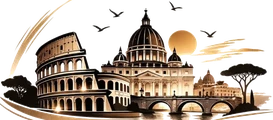
Rome: 2,800 years of history
The Eternal City is an open-air history book. Here is an essential guide to help you find your way through its most important centuries and discover the places that still tell the story of its greatness.
The founding of Rome
According to legend, Rome was founded by Romulus on 21 April 753 BC on the Palatine Hill. The city began as a small village of shepherds, destined to become the centre of the ancient world. Its first centuries saw a succession of seven kings, from Romulus to Tarquin the Proud.
What to see: Palatine Hill · Circus Maximus · Roman Forum
The Republic
Once the last king had been driven out, Rome became a Republic governed by the Senate and by two consuls elected every year. It was the age of great conquests, from Italy to the Mediterranean, and of figures such as Julius Caesar, Cicero and Scipio Africanus.
What to see: Roman Forum · Appian Way · Theatre of Marcellus
The Empire
Augustus, the first emperor, turned Rome into a city of marble. The Colosseum was inaugurated in AD 80 and the Pantheon rebuilt under Hadrian. Rome grew to around a million inhabitants. In 476, the fall of the Western Roman Empire brought an era to a close.
What to see: Colosseum · Pantheon · Trajan's Markets · Baths of Caracalla
Christian and medieval Rome
With Constantine and the edict of 313, Rome became the heart of Christianity: the great basilicas of St John Lateran, Santa Maria Maggiore and St Peter's were built. In the Middle Ages the city emptied, yet it remained the spiritual centre of Europe.
What to see: St Peter's Basilica · Castel Sant'Angelo · Medieval Trastevere
Renaissance and Baroque
The Renaissance popes turned Rome into the capital of art: Michelangelo painted the ceiling of the Sistine Chapel (1508-1512) and designed the dome of St Peter's, while Raphael decorated the Vatican Rooms. In the 17th century Bernini created the Fountain of the Four Rivers and St Peter's colonnade.
What to see: Sistine Chapel · Piazza Navona · Trevi Fountain · Villa Borghese
Rome, capital of Italy
In 1870 Italian troops entered the city through Porta Pia, and Rome became capital of the Kingdom. New districts sprang up, such as Prati, where our apartments are. Today Rome is a metropolis of almost three million people and one of the most visited cities in the world.
What to see: Altare della Patria · Prati · Piazza del Popolo
Rome: a user's guide
Book ahead
The Vatican Museums, the Colosseum and the Borghese Gallery need to be booked online several days ahead, especially in high season.
Comfortable shoes
The centre is best explored on foot, over the cobblestones: distances are short, but the ground is uneven.
Avoid peak times
Trevi, the Colosseum and the Vatican are far more enjoyable early in the morning or after 17:00.
Eat like a Roman
Wander two or three streets away from the monuments for better trattorias and fairer prices.
Getting around
The metro has three lines, but for the historic centre buses and trams are often more convenient. A ticket is valid for 100 minutes.
Free water
The ‘nasoni’, Rome's public drinking fountains, provide fresh drinking water all over the city: bring a refillable bottle.
Message us or call us
For bookings, information or special requests, you'll hear back from us personally. In Italian and in English.